
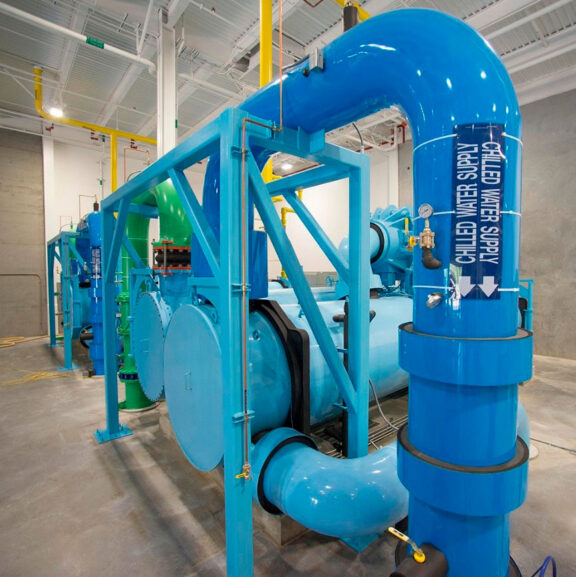
The Central Energy Facility (CEF) was completed and became operational in March 2015. Over the span of 5 years, record-setting heat waves caused loads to exceed the CEF’s chilled water production capacity impacting the Stanford research community and building operations. The CEF Expansion was necessary to increase chilled water capacity to align with the university’s new policy of zero curtailment days and to meet future campus growth.
PROJECT FEATURES
- Four 3,000-ton chillers providing 9,000 tons of total additional cooling capacity
- One chiller for redundancy
- Nine cooling towers
- Chilled water capacity nearly doubled in just over two years, rising from approximately 350 tons/hour to more than 700 tons/hour
PROJECT SUMMARY
In 2015, ACCO facilitated the conversion of Stanford’s steam, cogeneration plant into a new heat-recovery chiller plant. The Plant had supplemental conventional cooling and heating to obtain a more energy efficient campus. After a steady increase in cooling loads over five years, Stanford needed to increase the plant’s capacity to sustain campus demands. ACCO was contracted on a design assist basis to double the chilled water capacity of the CEF.
ACCO faced a number of challenges including OSHPD requirements while working in a live healthcare facility that serves the campus and university hospitals, an 11-month construction schedule amidst COVID restrictions, and supply chain disruptions. To overcome these challenges, ACCO ensured all field and project staff were familiar with the rigid confines of OSHPD regulations. ACCO enforced and adhered to strict COVID policies to ensure a safe and healthy working environment. ACCO maintained constant visibility across vendors, the general contractor, and the owner to manage expectations and minimize supply chain impacts. By doing so, ACCO was able to stay ahead of any major potential schedule or cost impacts. ACCO’s procurement team played a large part in the project’s success.
ACCO provided and installed all major equipment and mechanical systems required for the expansion. The scope included four additional 3,000-ton chillers, five pumps, nine cooling towers, and all plumbing, sheet metal, chilled/hot/condenser water piping and HVAC peripheral systems.
Despite the challenges, the project was completed on time and within budget. Success was driven by a fully integrated team approach, with ACCO management, BIM coordination, procurement, and fabrication shops all working together throughout the project.